


Key Points
- The Oldest Places in the World: A Glimpse into Ancient History
- The Pyramids of Giza, Egypt(c.2580-2560 BCE)
- Stonehenge, England (approx. 3000-2000 BC)
- The Great Wall- China, about 7th century B.C.
- The Incas Perus town of Machu Picchu (c. 1450 CE)
- Petra in Jordan (c: 5th century BCE)
- The Colosseum, Italy (c. 70-80 AD)
- The Acropolis of Athens, Greece (c. 5th century BCE)
- The Great Mosque of Djenne, Mali (c. 1907 CE)
Every place in this universe readily has some of the greatest incredible places with each of them harboring a story worth telling. Some of those wonderful places have stood for thousands of years, and it is only through this past that we learn what ancient civilizations achieved. They bring within their walls monuments from towering pyramids to crumbling ruins-the oldest places in the world that have become witnesses to history and will continue witnessing centuries of rising and falling empires-laying under most modern tourist feet today. This will explore some of the best stars in global travel-the iconic landmarks around the world, historical places in Egypt, and the world-famous monuments.
The Oldest Places in the World: A Glimpse into Ancient History
Aged locations are not only foundations but also symbols of mankind’s creativity, endurance, and ingenuity. These sites tell the stories of how ancient civilizations lived, built, and interacted with their environment. From the Great Pyramids of Egypt to the ruins of Machu Picchu in Peru, there’s no doubt these places are due to the skill and vision of ancestors.
Take off on a journey to discover some of these amazing places
The Pyramids of Giza, Egypt(c.2580-2560 BCE)
Giza’s pyramids are certainly among the most renowned historic sites in Egypt. Situated at the outskirts of Cairo, these ancient constructions stand amongst the oldest and most eminent landmarks in the world. The Great Pyramid of Giza designed for pharaoh Khufu is the largest and most colossal of the three pyramids. It originally stood at an altitude of 146.6 meters, but due to erosion, it currently has a height of 138.5 meters.
As it stands, both smooth and shiny limestone enveloped the pyramids and gave the shiny, reflective surface of a mirage that could be seen from miles away.
The Pyramid of Khafre and Pyramid of Menkaure are among those during this visit besides the Great Pyramid. The famous Sphinx adds extra exclusivity to the Giza Plateau-it is a gigantic statue made of limestone whose body is that of a lion and head that of Pharaoh Khafre. Giza pyramids have continued to attract millions of visitors every year, thus making them a true representation of Egypt’s ancient glory and among the most famous monuments worldwide.
Stonehenge, England (approx. 3000-2000 BC)
Not only is Stonehenge a remarkable manifestation of one of the oldest places on earth, but it is also a photographic example found nowhere else around the late 3000-2000 BCE period. Located in Wiltshire, England, a prehistoric avenue leads to these rings of standing stones, which have attracted multitudes of people over the eras. Although the reason behind Stonehenge’s existence remains unknown, experts think mainly it was used for ceremonial or religious purposes.
So enormous are the stones of Stonehenge; the majority stand over 400 cm tall, with the weights of some above 25 tons. The great stones, named sarsens, have been moved as far away as 20 miles, whereas the minor bluestones were found far away, some thinking that they derived from Preseli hills, Wales, nearly 200 miles away. The alignment of the stones with the sun motions, particularly the summer solstice, might suggest that Stonehenge was the ancient observatory or worship place.
Visiting Stonehenge is an invitation to regress into time and admire the capabilities of an ancient society that relied on nothing more than human effort and ingenuity to build what would now be considered impossible. It is one of the most dramatically evocative structures around the world, an iconic testimony to the cleverness and mystery of past civilization astonishingly different from our present age.
Incredible structure of architecture, The Great Wall- China, about 7th century B.C.
This is the Great Wall of China. Spanning over 13,000 miles in length, this astonishing structure is one of the greatest long walls made by men in the world. Various dynasties were involved in the construction of the Great Wall, starting in the seventh century BC, as a means for older Chinese populations to use as a barrier against invasions of nomadic tribes.
Of a bunch of walls built at various regions and times, the Great Wall isn’t a single continuous wall. Great Wall walls made different materials like wood, bricks, stones, earth, etc., depending on where it was built and the resources available. The most commonly known parts are made of bricks and stones, where tourists can visit and see because these are near Beijing.
The Great Wall of China represents resilience and Chinese determination. It ranks among some of the best landmarks in the world, which draw millions of tourists around the world every year. It is very easy to stay at the top of this Great Wall and only look over the extensive landscape to visualize how life was for those defending this area against outside invaders.
These are the archeological sites in the Incas Perus town of Machu Picchu (c. 1450 CE).
Machu Picchu is probably the most known historical site in the world. The Incas built this city high in the Andes Mountains of Peru around A.D. 1450. It was lost to them during the 16th century, most likely because of the entry of Spanish conquistadors into the region. Once again, it was discovered in the early 20th century by the explorer Hiram Bingham. Hence, it has become one of the most famous historical sites around the globe, attracting tourists from different regions.
An engineering marvel for the precision of stone construction, its agricultural terraces are highly advanced. Its elevation is an impressive 7970 feet above sea level. It’s terrible views of the mountain and valley surrounding it would make anyone proud of its hallowed grounds. The site itself boasts temples, plazas, and houses all masterfully designed for the most perfect natural incorporation.
But that’s not even all, as Machu Picchu itself is more than its architectural structures; it is in fact the epitome of the Incas in terms of culture, religion, and history. Today it ranks as one of the most famous monuments in the world and is, hence, a much-desired destination for world-history and culture lovers.

Petra in Jordan (c: 5th century BCE)
Petra is a city in southern Jordan carved out of the red sandstone cliffs. It used to be the capital of the Nabataean Kingdom, which was one of the most important and progressive culture and commerce centers of ancient time. Moreover, it was one of the most important trading cities in the world. The city was abandoned in the 7th century CE and lay hidden from the outside world for centuries until it was rediscovered in the early 19th century.
Among the many things one can see in Petra is perhaps the most famous, Al-Khazneh, or the Treasury – a gigantic tomb carved straight into the face of the rock. Besides Al-Khazneh, there are also tombs, temples, and other structures, all very dramatically carved into cliffs throughout the Petra site. The site is recognized as a UNESCO World Heritage site and stands as one of the most emblematic monuments in the world.
Petra is often termed “Rose City” since the stone used to carve out the city is “rose” colored. The impressive architecture and enthralling past make it among the oldest worth visiting worldwide in terms of landmarks.
The Colosseum, Italy (c. 70-80 AD)
The historic site of the Colosseum is situated in the heart of Rome and is titled one of the most popular and best-preserved sites of all time. The Colosseum was constructed during the years 70-80 CE under the rule of Emperor Vespasian and his son Titus with which he has linked gladiatorial contests, public spectacles, and other forms of entertainment.
Originally, the Colosseum could host in the range of 50,000 to 80,000 spectators. That makes the Colosseum an architectural marvel of its time. Contained an elaborate system of tunnels and elevators that would raise animals and gladiators into the arena. For the purpose of entertainment, it is much more important; it is also the symbol of Roman engineering, architecture, and imperial power.
It still remains today as one of the most celebrated monuments in the world drawing in millions of tourists every year. Its sheer magnitude and its incredible historical richness make it a must-see for anyone within the ancient world.
The Acropolis of Athens, Greece (c. 5th century BCE)
Of all the monuments of ancient Greece, the Acropolis of Athens comes second in contest against dials with regard to the picturizing of the space. A high, rocky hill had formerly occupied the high point of the religious and political center of ancient Athens. The most famous construction on the Acropolis is the Parthenon, a temple dedicated to the goddess Athena, who was believed to be the protector of the city.
From its columns and detailed sculptures, the Parthenon is one of the most recognizable buildings in the world. The Acropolis also includes important structures such as the Temple of Athena Nike, the Erechtheion, and many others. To overemphasize, overmuch words alone will be used up: the importance of the actual site cannot be disputed because it has historically served significant development for the West.
The Acropolis of Athens is a UNESCO World Heritage site and one of the world’s best landmarks; it never fails to attract people from around the globe in admiration of its worth and learning of ancient Greek history.
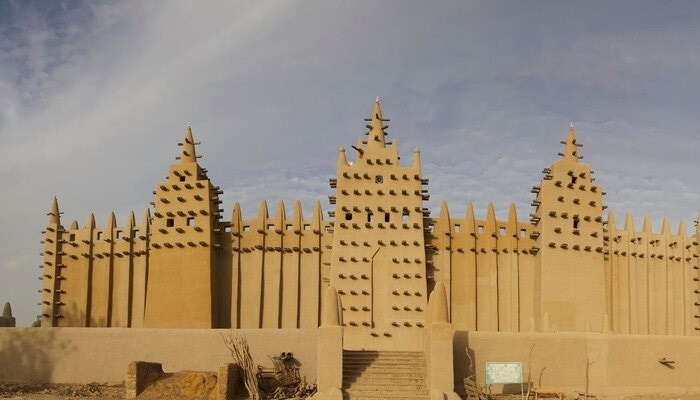
The Great Mosque of Djenne, Mali (c. 1907 CE)
In its city, Djenne, located in Mali, lies the largest mud-built structure in the entire planet – the Great Mosque of Djenné. Originally constructed in the 13th century, the mosque was brought back to this form in 1907 after being partially destroyed. Made from sun-baked mud bricks and adorned with wooden beams, the mosque is a stunning example of traditional Sahelian architecture.
It is called the Great Mosque of Djenné, which serves as a place of worship for the religious people, but most of all, it has become a symbol of the glorious past and culture of this region. It is really one of the prolific monuments in the whole world-one of its kinds-in respect to the number of it being coined into the memorial by peoples of immense architectural strengths who produced it.
FAQs
What is the oldest place in the world?
Among the oldest places are Jericho, Petra, and the Great Pyramid of Giza. These places take roots deep in ancient history for thousands of years.
Why are places so important?
It gives us a view of the early human civilization as well as its culture.
Where is the oldest city?
Jericho, in Palestine, is regarded as one of the oldest cities that still exist today.
Conclusion
The oldest places in the world are not merely scenes from history but also windows leading into the past and revealing how the ancient civilizations have shaped this world we live in today. We have thousands of international monuments, from the Egyptian pyramids to the temples of Greece each stands as a testament to the amazing ingenuity, hard work, and vision of the human race. A visit to such a site is not just a learning experience, but also a glimpse into the past legacies for which people built their greatness. These places provide glimpses into human tales and accounts.
Leave a Reply